
MODFLOW Flow Family#
This page groups the scientific notes for MODFLOW-family flow solvers.
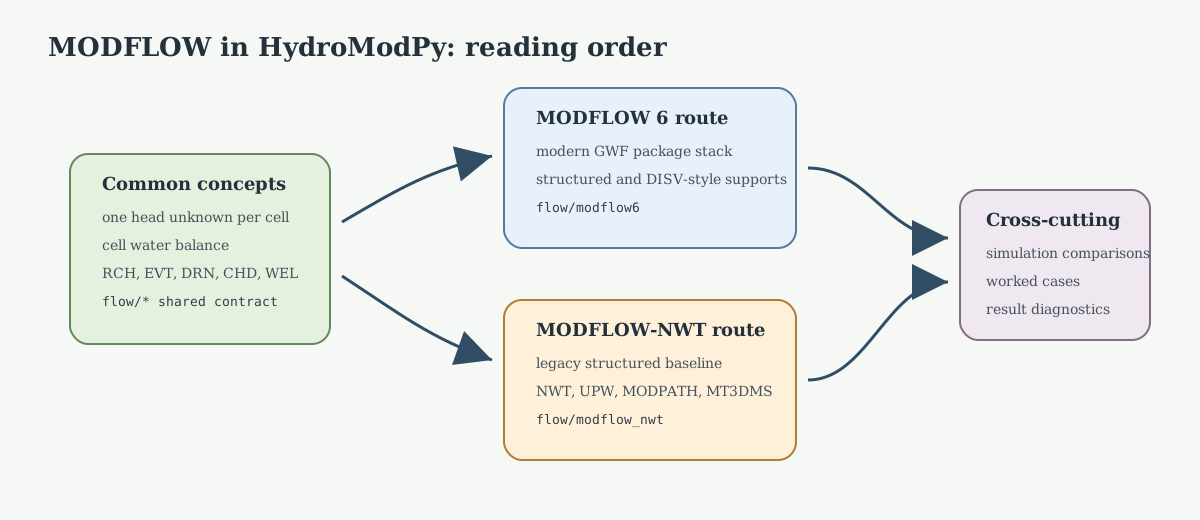
Fig. 49 Start from the shared MODFLOW concepts, then choose the modern MODFLOW 6 route, the legacy MODFLOW-NWT route, or the cross-cutting comparison pages. This avoids mixing backend-specific details before the common groundwater balance and package vocabulary are clear.#
Read this family as three explicit blocks:
Block |
Main page |
Purpose |
|---|---|---|
Common MODFLOW part |
Shared groundwater-flow vocabulary: governing equation, package semantics, boundary mapping, stress periods, vertical assumptions, and comparison discipline. |
|
MODFLOW 6 version |
Modern MODFLOW 6 GWF route for |
|
MODFLOW-NWT version |
Legacy MODFLOW-NWT route for |
In HydroModPy, the two active MODFLOW-family flow versions are:
flow/modflow_nwt: legacy MODFLOW-NWT route, structuredsgridsupport, and compatibility with MODPATH and MT3DMS.flow/modflow6: modern MODFLOW 6 route, including structured grids and runtime DISV-style unstructured meshes where supported.
Result Examples#
The MODFLOW family pages should be read with real output figures in mind. The two examples below are useful first anchors:


Internal pages#
Quick reading order#
If you do not know where to start:
MODFLOW Governing Equation And CVFD Formulation for the shared groundwater balance.
MODFLOW 6 Flow if you use the modern MODFLOW 6 path, or modflow_nwt if you use the legacy MODFLOW-NWT path.
Comparison And Method Choice and Transport Coupling once the chosen backend is clear.
Worked MODFLOW Cases to anchor everything in a concrete run.
Surface Exchange And Active-Network Reading#
For stream supports, seepage, drainage outflow, and simulated active-network diagnostics, use the dedicated scientific section before reading backend details:
Conceptual Model explains the modelling decisions: stream boundary, seepage/drainage operator, and post-solve active network.
Worked Examples lists the examples that connect those decisions to commands, files, and figures.
Status And Limitations states what is implemented, what is demonstrated, and what is still a non-contract.
Simulated Active Network explains the MODFLOW 6 result ladder from
outflow_draintoaccumulation_fluxand the thresholded active-network view.
This separation matters for MODFLOW-family comparisons. MODFLOW-NWT is the legacy structured baseline. MODFLOW 6 is the modern path where mesh topology and result extraction must be explicit enough to support routed active-network diagnostics.
Backend Version Summary#
Version |
Shared MODFLOW concepts repeated in that page |
Version-specific emphasis |
Downstream transport |
|---|---|---|---|
|
Flow equation, recharge, wells, storage, imposed heads, drainage, stress periods, package semantics. |
MODFLOW 6 package stack, structured or DISV-style support, XT3D, modern output and GWT compatibility. |
|
|
Flow equation, recharge, wells, storage, imposed heads, drainage, stress periods, package semantics. |
Structured-grid continuity, historical MODFLOW-NWT behavior, legacy package assumptions, MODPATH and MT3DMS compatibility. |
|
Selection Notes#
Solver |
Prefer when |
Be careful when |
|---|---|---|
|
You need continuity with legacy structured-grid workflows or downstream MODPATH / MT3DMS transport. |
You need runtime Gmsh/DISV-style irregular mesh support. |
|
You need modern MODFLOW package semantics, irregular mesh support, or MODFLOW 6 GWT transport compatibility. |
You compare against legacy studies whose numerical assumptions were calibrated on MODFLOW-NWT. |